
DRDO is Developing a new S-Band Instrumentation Tracking Radar
NEWS
Durgesh Singh
7/10/20262 min read
Introduction
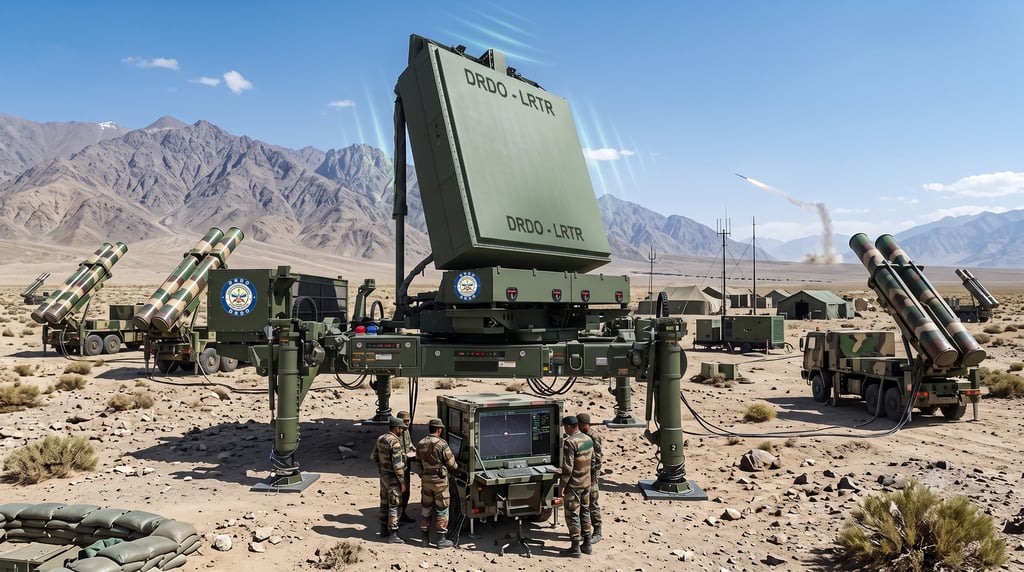
The S-Band Instrumentation Tracking Radar is an advanced multi-target tracking system designed to track short-range targets in "skin mode" (echo reflection) and medium-to-long-range high-altitude missiles in transponder or beacon mode. Built on Active Phased Array technology, it is intended to seamlessly integrate with existing range sensor networks to meet the automatic search and track requirements of critical flight test scenarios, such as ballistic missile trials and air defense.
1. Technical Specifications
The radar's technical parameters ensure high precision and reliability for tracking dynamic aerial targets across varying distances.
Core Characteristics and Performance:
Operating Frequency: S-Band, ranging from 2900MHz to 3300MHz.
Technology: Employs Solid-state Active Phased Array and Digital Beam Forming (DBF).
Target Types: Capable of tracking skin objects (aircraft, cruise/tactical missiles, boosters, and stages) as well as beacon objects (ballistic payloads).
Skin Range: >/=250km for 2msq target @14db SNR
Minimum Detection Range: 3.0 Km in both skin and beacon modes.
Tracking Capability: Aircraft, Tactical Missile, Stages/Booster for Missile
Electronic Scan: +/- 50 Degree Azimuth & 0-70 Degree Elevation
Resolution: 150m in Range, 3 Degree in angle
Power Aperture Product: >/=124 dBW (Transmit Gain + Receive Gain + Peak Power).
Target Types: Low RCS (0.1-1.0m 2) missiles, Cruise missiles, Aircrafts, Medium Range Ballistic Missiles (:s400km @ RCS " 1m2) and Boost phase of Long Range Ballistic Missiles. The target Doppler for Medium Range Targets (< 400 km) is limited to 1500 m/s. For long range ballistic missiles Doppler limit is 4500m/s. It should have both high range resolution & low range resolution mode required for different class of targets. Additionally by non coherent mode processing, It should track long range targets with onboard transponder within the LOS.
Radar Configuration (Re-locatable):
1. Radar Antenna Array Unit with motorized slewable (at least± 70°) pedestal with locking mechanism at 5 degree interval in azimuth
2. Motorized elevation folding mechanism
3. Radar Processing Electronics & BITE
4. .Rectifier Unit
5. Liquid Cooling Unit with redundancy
6. Radar Monitoring& Control System (with remote operator console)
7. Self Calibration
Measurement and Accuracy (4D Tracking):
The radar captures Range, Azimuth, Elevation, and Doppler measurements equipped with timestamps.
Accuracy (1 sigma or better): * Range: </= 20m.
Angle: </=1/10th of the beam width.
Radial Velocity (Doppler):</= 4 m/s.
Resolution:
Range: High </=75m, Low </=200m.
Azimuth & Elevation: </=1.5 Degree(Azimuth) and </=3.2 Degree (Elevation).
Doppler: </=10 m/s.
Scanning and Mechanical Posture:
Electronic Scan: +/- 50 Degree Azimuth & 0-70 Degree Elevation
Mechanical Tilt: The antenna operates in a staring mode with tilt provisions of 12 Degree (default), 40 Degree for high-elevation/high-speed targets, 0 Degree for maintenance, and 90 Degree for transportation.
2. System Architecture and Composition
The seller must integrate and supply a comprehensive suite of subsystems:
Active Antenna Array Unit (AAAU): Features the radiating panels, Transmit/Receive (TR) modules, Exciter, DBF unit, multi-channel receiver, and beam steering unit.
Mechanical & Thermal Systems: Includes a motorized slewable pedestal assembly, a redundant Liquid Cooling Unit (LCU), an antenna cabin with a radome, and an external protective dome-shaped radome.
Power Systems: Consists of a Rectifier Unit, Power Distribution Units (PDU), and integrated electrical accessories like lightning arrestors and earthing systems.
OPS Shelter: An air-conditioned operational shelter providing 60 dB or more of isolation. It houses the Radar Processing Unit (RPU), Wide-band recorder, 2 monitoring/display consoles, and up to 10 high-performance workstations for data post-processing.