
DRDO' RFP For Lead System Integrator in Low Frequency, Bow Mounted Sonar Development
The scope of work of Lead System Integrator (LSI) for Technologies for Low Frequency, Bow Mounted Sonar (T-LFBMS) involves detailed design, development, and integration testing at various test facilities, followed by certification and installation onboard a designated naval platform.
NEWS
Durgesh Singh
7/8/20263 min read
The Role of the Lead System Integrator in T-LFBMS Development
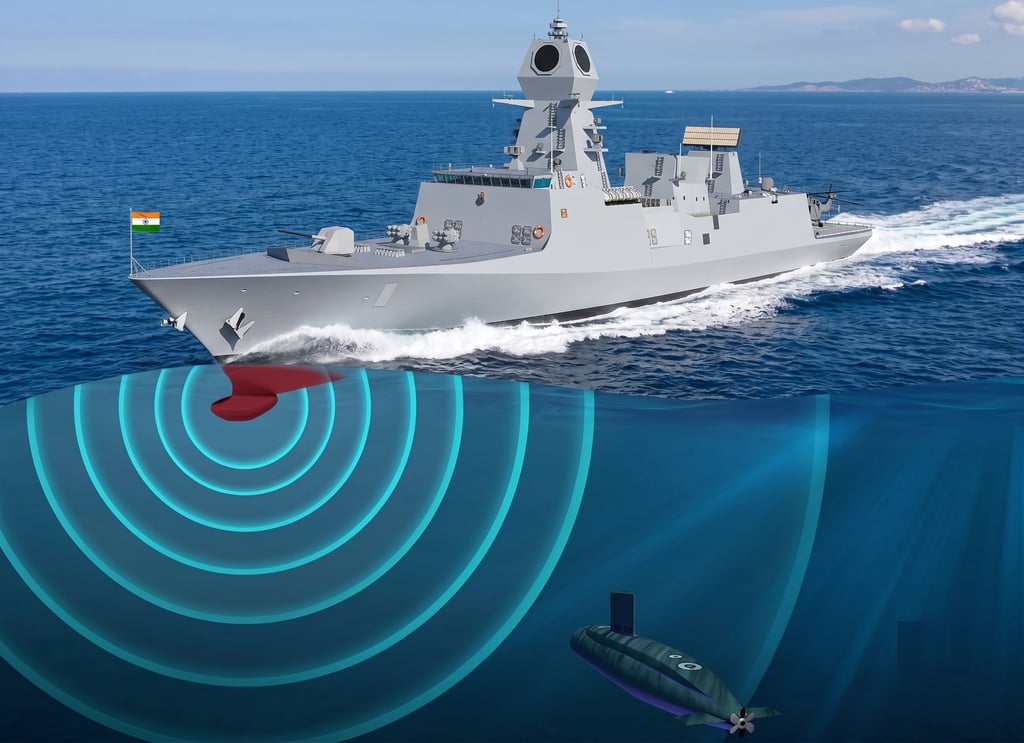
The Technologies for Low Frequency Bow Mounted Sonar (T-LFBMS) is a state-of-the-art Hull/Bow Mounted Active Sonar System intended for installation on naval platforms. Realizing this complex naval defense project requires the expertise of a Lead System Integrator (LSI), who is responsible for developing, integrating, and evaluating the system, as well as managing its installation and sea trials.
1. Core Definition and Purpose
Location: It is a Hull/Bow Mounted Active Sonar System, meaning it is physically integrated into the front (bow) of a naval platform's hull.
Low Frequency Operation: The system operates at low acoustic frequencies, specifically defined in the document as having an operating frequency of less than 5kHz. Low-frequency sound waves travel significantly farther underwater than high-frequency waves, allowing the warship to detect submarines and other underwater threats at much greater ranges.
Active Sonar: As an "active" sonar system, it generates its own acoustic pulses (pings) using power amplifiers and transmitters, and then "listens" for the echoes returning from targets.
2. Key Physical Components
An LFBMS is a massive and complex system divided into "wet-end" (underwater) and dry-end (inside the ship) components:
The Transducer Array: This is the heart of the sonar, consisting of hundreds of individual acoustic sensors (transducers and hydrophones) mounted on a large titanium Array Structure. For the T-LFBMS project, this structure alone weighs 4.4 tons and is roughly 2.4 meters tall and 2.2 meters in diameter.
The Composite Sonar Dome: The transducer array is completely enclosed within a streamlined composite dome attached to the ship's hull. This dome provides structural stability, protects the array, and is acoustically transparent so sound can pass through it easily. It also significantly reduces the interference caused by water flowing past the ship (flow noise) and vibrations from the ship itself (structure-borne noise).
Water-Filled Environment: In normal operating conditions, the inside of the dome is filled with filtered fresh water or demineralized water and maintained under positive pressure using a pressure balancing system to match external sea conditions.
3. Acoustic Insulation
To ensure the sonar only picks up targets in the ocean and not the noise of its own ship, the compartment above and around the dome is heavily treated. Exposed metallic surfaces inside the sonar dome compartment are covered with 51mm acoustic rubber tiles, while other areas receive specialized vibration-damping coatings (like P-8 GRP and Mastic coatings) to isolate the array from the ship's mechanical noise.
Scope of Work for the LSI
The LSI serves as the central hub for the project's execution, with responsibilities spanning the entire system lifecycle:
Design & Development: The LSI must carry out the detailed design, development, integration testing, and certification of the main operator consoles (Display, Workstation, and Portable Control Consoles). Additionally, the LSI is tasked with designing the Underwater Junction Box and the connecting cable infrastructure.
Subsystem Acceptance & Factory Integration: The LSI acts as the formal accepting authority for various subsystems sourced from designated firms approved by NPOL. They must jointly develop Acceptance Test Procedures (ATP) with these vendors. The LSI is required to establish a high-performance system integration facility at their own premises to conduct factory integration for both the T-LFBMS System and the Reference System.
Evaluation at Specialized Facilities: The LSI will integrate the Transducer Array and other subsystems for extensive evaluation at the NPOL Tank and the Underwater Acoustic Research Facility (UARF).
Shipboard Installation: The LSI oversees the complex physical installation of the T-LFBMS onto the designated naval platform during the ship's dry-dock period. This includes coordinating with the shipyard to set up storage and fixtures, installing the composite sonar dome and transducer arrays, and routing all necessary onboard cabling and electronic cabinets.
Trials, Analysis & Lifecycle Support: Beyond physical integration, the LSI must provide comprehensive lifecycle maintenance support and conduct Sea Acceptance Tests. They are responsible for post-trial data analysis and executing hardware or software corrections to tune system performance.
Engineering & Documentation: The LSI will deploy technical resources—including mechanical, electronics, and computer science engineers—to NPOL premises to assist with the development. The LSI is also responsible for extensive engineering documentation, including 3D modeling of the consoles, structural and thermal analysis, reliability reporting, and detailed cabling assembly specifications.