
Rolls-Royce's Pearl 700 engines successfully powered the first flight of the Gulfstream G800 using 100% Sustainable Aviation Fuel
The flight was part of Gulfstream Aerospace’s high-altitude flight test campaign, demonstrating the potential for 100% neat SAF to reduce contrail-forming particle emissions at altitudes up to 50,000 feet.
PRESS RELEASE
Rolls Royce
7/8/20261 min read
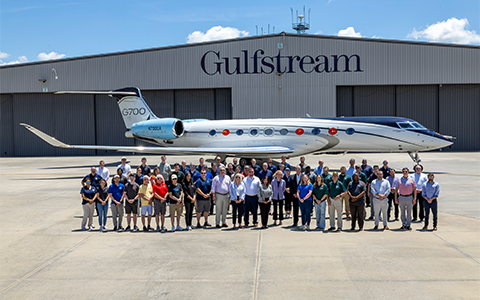
The aircraft was paired with a specially modified Gulfstream G700, which is also powered by Pearl 700 engines, and was transformed into a flying emissions measurement laboratory. Operating in close formation, the aircraft enabled researchers to capture precise, real-world measurements of particulate matter and contrail-forming atmospheric characteristics at higher altitudes than flown by most commercial airliners, yet typical for business aviation.
Led by Gulfstream Aerospace and conducted in close collaboration with the Federal Aviation Administration (FAA), NASA, the German Aerospace Center (DLR), Missouri University of Science & Technology, Rolls Royce, Aerodyne Research, Montana Renewables and World Fuel Services, the campaign was designed to isolate how different fuel compositions influence non-CO2 emissions, an area of increasing focus across science and industry.
To accomplish this, the team compared conventional Jet-A aviation fuel, low-sulfur Jet-A, and neat HEFA (Hydro-processed Esters and Fatty Acids) SAF, which contains no sulfur or aromatics. Preliminary results suggest a significant, measurable reduction in the particulate emissions that contribute to contrail formation when operating on neat SAF.